Bonding Over Food
People often assume that when John Spiegel and I launched the Zero Trust Forum and the No Trust Podcast, we had been friends for years and must have spent months sitting in the same room, planning everything over coffee or dinner. The reality is far more modern, and frankly, far more amusing. By the time the forum and podcast were already underway, John and I had still never actually met face to face.
L5M
Jaye Tillson
3/10/20265 min read
Bonding Over Food
People often assume that when John Spiegel and I launched the Zero Trust Forum and the No Trust Podcast, we had been friends for years and must have spent months sitting in the same room, planning everything over coffee or dinner. The reality is far more modern, and frankly, far more amusing. By the time the forum and podcast were already underway, John and I had still never actually met face to face.
Our entire collaboration up to that point had happened remotely. Video calls, messages, ideas bouncing back and forth across time zones. Like many professional relationships that started during and after the pandemic era, everything began digitally. Conversations that were supposed to last thirty minutes would often stretch into an hour or more as we debated security trends, discussed what was happening in the industry, and shared experiences from our respective careers.
Originally, the idea started with something a little narrower. The community was initially launched as the SSE Forum, focused specifically on Secure Service Edge and the rapidly evolving world of cloud-delivered security. Alongside it, we launched The Edge Podcast, which aimed to bring practitioners together to discuss the practical realities of deploying these technologies.
However, it did not take long for both of us to realise that the conversations were naturally drifting into something much broader.
SSE was certainly part of the story, but the discussions kept circling back to a bigger architectural and strategic concept: Zero Trust. Identity, segmentation, device posture, data protection, cloud access, and user behaviour. All of these elements were interconnected, and trying to talk about them purely through the lens of SSE felt limiting.
So we made a decision.
The SSE Forum evolved into what is now the Zero Trust Forum, giving us the freedom to discuss the wider architecture and strategic challenges organisations face when implementing modern security models. The Edge Podcast also evolved into what many people now know as the No Trust Podcast, where the same spirit of open conversation continued, but with a broader lens.
John and I had already spent months talking regularly. Yet despite all of that collaboration, we had never actually met in person.
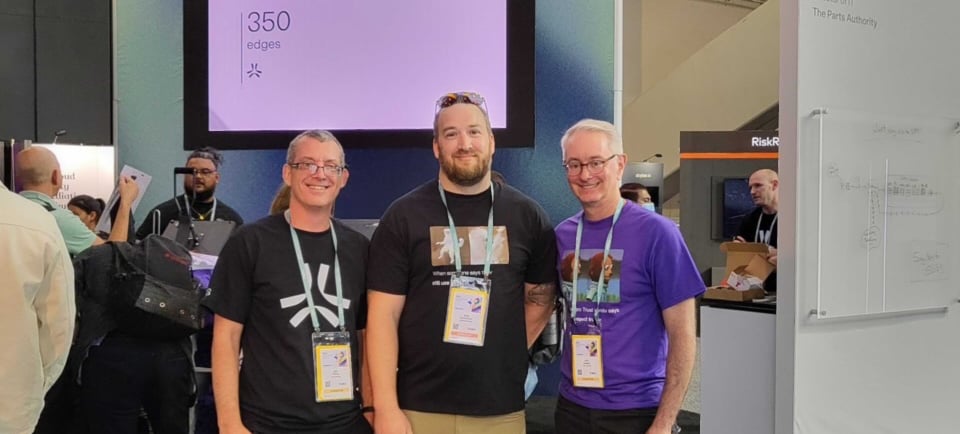
That moment finally arrived at the RSA Conference in 2022.
I had flown into San Francisco the day before and checked into my hotel. Anyone who has attended RSA knows the rhythm of the week. It is one of the largest cybersecurity gatherings, and once Monday arrives, the pace becomes relentless. Meetings begin early in the morning, the expo floor opens, and before you know it, the day has blurred into evening receptions and late-night conversations.
Arriving the day before always helps. It gives you a chance to shake off the jet lag, adjust to the time zone, and mentally prepare for what is always a very busy week.
John arrived on Sunday and jumped into a taxi to come and collect me from my hotel. That first handshake was one of those slightly surreal moments where it felt strangely normal, as if we had already known each other for years. In truth, by that point, we probably had. When you speak to someone frequently enough, you develop a sense of familiarity that makes the eventual meeting feel less like an introduction and more like a continuation.
From there, we headed into San Francisco together and spent the day wandering around the Fisherman’s Wharf area. No agenda. No meetings. Just two cybersecurity people exploring the city before the chaos of RSA began.
Fisherman’s Wharf is one of those places that perfectly captures the atmosphere of San Francisco. The views across the bay are incredible, the smell of seafood fills the air, and every corner seems to have another café, restaurant, or street performer. We watched the sea lions lounging around near Pier 39, looked out toward Alcatraz in the distance, and spent the afternoon simply talking.
It was relaxed, informal, and exactly what you want before a busy conference week.
Eventually, as most good days do, it led us to food.
We ended up sitting down at a Thai restaurant not far from the waterfront. I do not remember exactly which dishes we ordered, but I do remember the conversation that followed. What was supposed to be a simple meal quickly turned into a long discussion about cybersecurity, the industry, and just getting to know each other.
Food has always been something I enjoy, although sometimes my tastes are admittedly a bit selective. I tend to gravitate toward the things I know I like. John, on the other hand, approaches food like an explorer. For him, every new city represents an opportunity to try something new, whether that is a different cuisine, a local specialty, or something neither of us has ordered before.
That first Thai meal turned into one of those conversations where time disappears. We talked about the evolution of security architecture, the gap between theory and execution, and the practical challenges organisations face when trying to modernise their security programs.
But we also talked about life, travel, and the strange rhythm of spending large parts of the year moving between airports and conferences.
Deep down, I had already felt that John and I would get along. When you collaborate closely with someone over months of calls, you develop a sense of how their mind works. You learn how they think about problems and how they approach discussions. But sharing that first meal confirmed the instinct.
The conversation flowed easily, the humour was there from the start, and it became clear that this partnership was going to work.
Since then, we have shared many meals around the world at conferences and events. San Francisco, Las Vegas, Barcelona, and plenty of airport restaurants in between. Some have been quick meals squeezed between sessions, others have been long dinners where the conversation continues well into the evening.
If there is one consistent theme across those meals, it is John’s ongoing mission to expand my food repertoire.
Every new destination seems to present another opportunity for him to introduce me to something new. Sometimes it works. Sometimes I remain unconvinced. But he never gives up trying.
There is, however, one debate that has become something of a running joke between us.
Pineapple on pizza.
John firmly believes it belongs there. I firmly believe it does not.
Over the years, this has become a light-hearted yet persistent argument that seems to resurface whenever pizza is involved. In fact, the lengths he has gone to to prove his point have become increasingly elaborate.
My personal favourite example happened at Black Hat in Las Vegas.
We were recording a live episode of the No Trust Podcast from our booth on the show floor. The booth had attracted a small crowd of people listening to the conversation and watching the recording take place.
Partway through the session, one of our colleagues suddenly appeared, walking toward the booth dressed in a full pizza delivery outfit. Hat, shirt, pizza boxes stacked in his hands. The audience, understandably, had no idea what was about to happen.
Inside the boxes were several different types of pizza. Every single one of them contained pineapple. John had clearly been planning this moment for some time.
Live on the podcast, with an audience watching, I was handed slice after slice and encouraged to give them a try. Hawaiian pizza, pineapple with jalapeños, pineapple with other toppings that John insisted would finally convince me.
And here is the extremely well-kept secret. It was not as bad as I remembered.
Now, before John reads this and claims victory, let me be clear. It was tolerable. Perhaps even mildly acceptable under very specific circumstances.
But it does not change my opinion. Pineapple still does not belong on pizza.
What it does highlight, though, is something that sits at the heart of the Zero Trust Forum. Many of the best ideas, partnerships, and friendships in our industry do not start in formal meetings or boardrooms. They start in simple conversations between people who share experiences and perspectives.
Often, those conversations happen over food.
That first Thai meal in San Francisco confirmed that John and I worked well together.
Every meal since has simply reinforced it.