Ransomware 2025: From Malware to Board-Room Risk
Ransomware has evolved into a business crisis. Explore 2025 data on extortion trends, stock price impacts, and what CISOs must do next.
John Spiegel
11/5/20254 min read
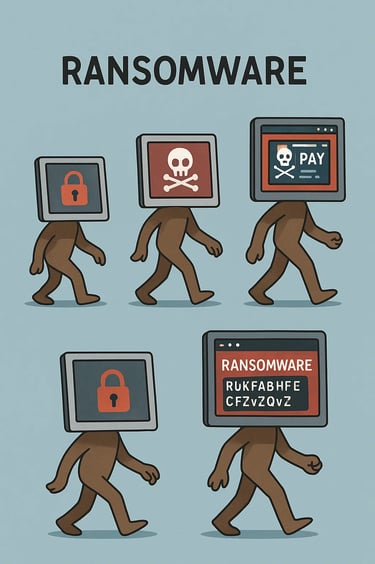
Ransomware isn’t what it used to be. What started as a crude, brute-force encryption shakedown has evolved into a sophisticated, enterprise-grade threat model that spans identity compromise, data exfiltration, AI-driven social engineering, and insider-risk vectors. It’s no longer just a technical issue, it’s now a business issue. And the consequences are measurable: share-price dips, executive misalignment, and operational disruption.
Three recent reports make that clear. EY’s 2025 “Bridging the C-Suite Disconnect” found that 84% of senior leaders experienced at least one cyber incident over the last three years. Those incidents correlated with an average 1.5% decline in share price within 90 days for Russell 3000 firms. That number might sound small, but it scales quickly. Additionally, multiple academic studies put the range higher. Morningstar Sustainalytics, NBER, and Oxford Economics all show public companies losing between 1% and 5% of market value after a breach, with more severe or repeated incidents reaching 7–9%. Consumer-facing sectors, financial services, and technology firms see the steepest declines.
Meanwhile, CrowdStrike’s 2025 State of Ransomware and Global Threat Reports found that 76% of organizations admit they can’t match the speed of AI-powered attacks, with nearly half naming AI-automated attack chains as their greatest ransomware risk. And in CoveWare’s Ransomware Q3 2025 update, ransom payment rates fell to a record low of 23%, while the average ransom amount dropped by nearly two-thirds from the previous quarter.
Taken together, the data paints a stark picture: attackers are professionalizing, defenders are adapting, and the entire ransomware economy is in the middle of a reset.
The Business of Ransomware
Adversaries have become far more business-like. Over the past two years, they’ve evolved into agile, identity-focused, and economically driven operators. CrowdStrike describes them as “enterprising adversaries”. These are threat actors who innovate faster than many defense programs. Nearly 80% of detections are now malware-free, relying instead on credential theft, lateral movement, and “living off the land” tactics that use a company’s own tools against it.
CoveWare’s data reinforces what we’re seeing across the industry: encryption is no longer the main play. Most campaigns now focus on data exfiltration-only or “double-extortion,” where the threat of exposure replaces the encryption key as leverage.
This is where many organizations misjudge the risk. Ransomware today isn’t about data being locked — it’s about trust being broken. The modern attack chain targets identity, privilege, and cloud misconfigurations as much as endpoints. If your defense model is still built around “encrypt → pay → restore,” you’re already behind.
The Speed-and-Scale Problem
Response is now measured in minutes and hours, not days or weeks. CrowdStrike’s finding that three-quarters of organizations can’t match the pace of AI-powered attacks. This is a red flag for the entire industry. Attackers are experimenting with both new AI techniques and economic models, driving faster breach cycles and shorter negotiation windows.
The takeaway is simple: the window for detection, containment, and recovery keeps shrinking. That demands an operational shift. Defenders must move to continuous monitoring, tested incident response plans, tabletop exercises, and cloud-native recovery capabilities. Traditional backups aren’t enough if your identity infrastructure is compromised or your SaaS tenants are being held hostage.
CoveWare’s decline in payment rates is encouraging. It means defenders are becoming more resilient but it also shows that both sides are upping their game. The good guys are learning, but so are the bad ones.
The C-Suite Disconnect
EY’s data reveals a widening gap between CISOs and their executive peers. Two-thirds of CISOs believe the threat landscape has outpaced their defenses but barely half of other executives agree. That gap isn’t philosophical; it’s financial. EY found that organizations embedding cybersecurity early in major initiatives, the so-called “Secure Creators” generate better outcomes, adding an average of $36 million in value per program.
The broader research reinforces the risk: recall that multiple studies show that publicly traded companies lose 1–5% of market value within 90 days of a breach, and in high-impact or repeat cases, as much as 7–9%. The damage doesn’t just hit the balance sheet, it hits brand equity and investor confidence. Consumer-facing, financial, and tech sectors are the hardest hit because customer trust is their currency.
For boards and executives, this marks the pivot point. Security isn’t a compliance checkbox anymore; it’s an operational resilience and market-trust driver. When the next ransomware event hits, investors and customers won’t ask, “What patch was missing?” They’ll ask, “Why weren’t we ready?”
Falling Payments, Shifting Risk
It’s easy to cheer declining ransom payments as progress but that’s a half-truth. CoveWare’s 23% payment rate shows improvement, but the underlying threat hasn’t gone anywhere. Data exfiltration, insider collusion, and brand-level extortion remain powerful levers. Attackers will always chase the money. If ransom stops paying, they’ll pivot to data monetization, insider recruitment, or destructive disruption.
The goal isn’t to pay less; it’s to be resilient enough not to pay at all. That means faster detection, stronger segmentation, and airtight identity governance.
What Leaders Should Do Now
Across all three reports, five strategic priorities stand out:
Make identity the control plane. Move to least privilege, enforce MFA everywhere, and shift toward risk-based authentication. Treat identity as the new perimeter.
Double down on resilience and recovery. Test your restores, segment your backups, and run full-scope tabletop exercises that include leadership, comms, and legal. (Shameless plug: the company I work for is running a national program called Race Against Ransomware. Reach out if you want in.)
Use AI defensively. If adversaries are using AI to speed their attacks, defenders need to use it to close the loop. This includes automate detection, accelerate containment, and enhance visibility. We’re early in this game, but it’s moving fast.
Bridge the C-suite gap. Translate risk into business language. This is key. Talk in terms of operational disruption, brand damage, and share-price risk. That’s what resonates in boardrooms.
Prepare for new extortion models. Build disclosure, negotiation, and insurance playbooks before the crisis hits. You’ll need them.
The Bottom Line
Ransomware in 2025 isn’t just a cybersecurity issue. It’s now a stress test for business resilience. Adversaries are innovating with AI, exploiting identity, and weaponizing data, while defenders are finally making ransom payment the exception, not the rule. The new playbook isn’t avoid the hit, it’s absorb, recover, and outpace.
As the economics of extortion shift, the winners will be the organizations that unify identity, AI-driven defense, and board-level alignment into one operating framework of Zero Trust.